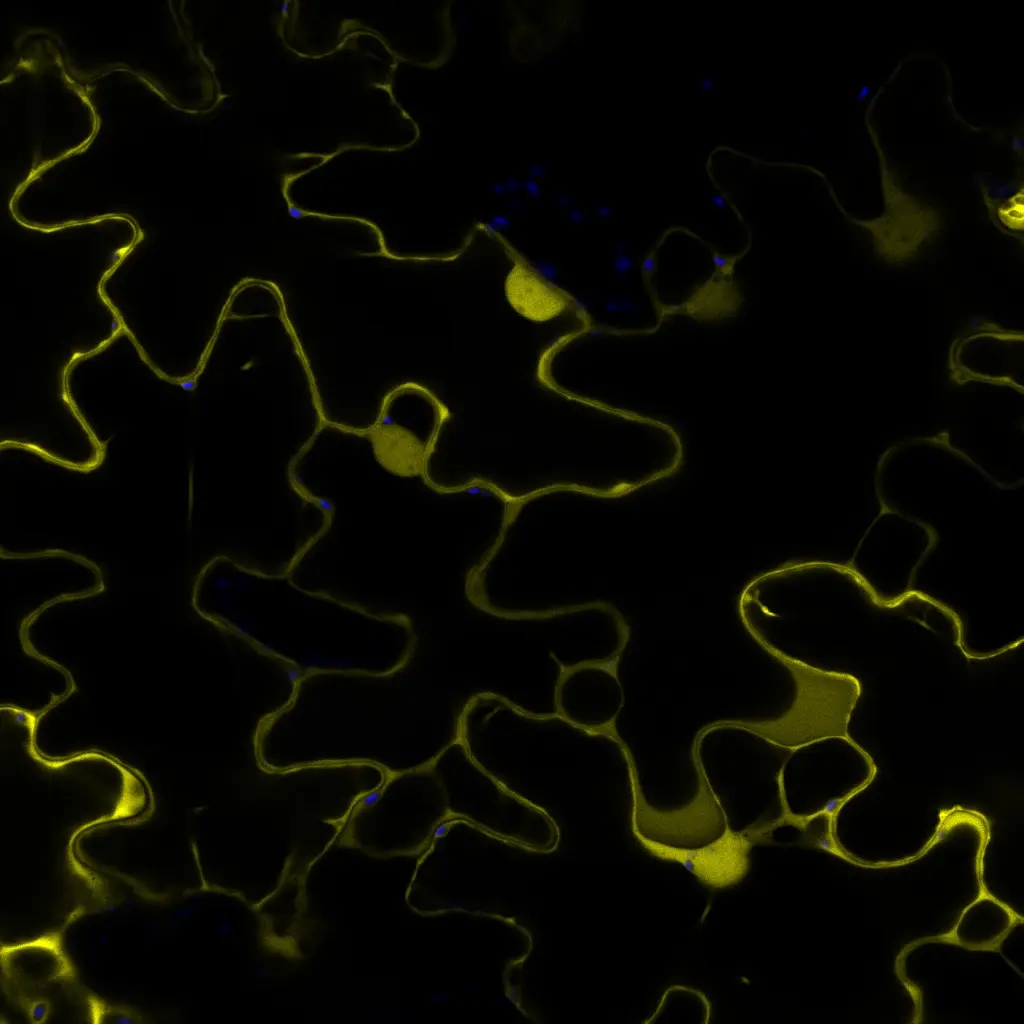
Striking image 1. Rhizobium rhizogenes AS109 enables transient green fluorescent protein (GFP) expression in faba bean leaves. Confocal micrograph taken by Dr. Tarhan Ibrahim.
A broad bean leaf might seem an unlikely place to explore the future of food security. But inside its cells lies a defence system that could help researchers understand how to protect the crops that feed people and livestock.
Plants cannot move away from danger. Instead, they rely on molecular defences to detect invading pathogens and respond. Understanding those systems could help scientists identify ways to strengthen disease resistance in crops we depend on.
Researchers have now developed a tool to investigate these processes directly in broad bean leaves, enabling experiments in crops that have been difficult to study.
The research brings together Imperial College London, Academia Sinica and National Chung Hsing University in Taiwan, the University of Cambridge’s Crop Science Centre, the John Innes Centre and The Sainsbury Laboratory in Norwich.
The story begins, however, with a plant more familiar to laboratories than dinner plates.
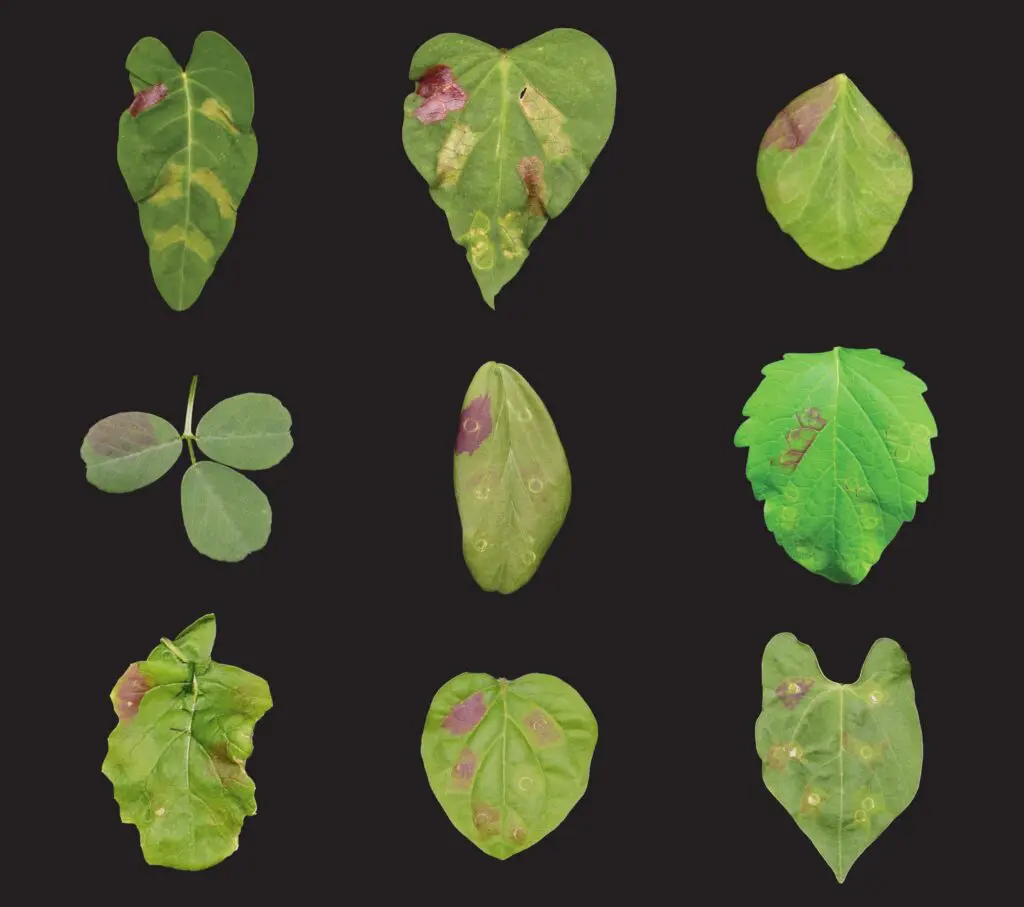
Striking image 2. Rhizobium rhizogenes AS109 facilitates RUBY reporter expression across diverse crop species. Photographs taken by Juan Carlos Lopez-Agudelo.
Why study our food in a tobacco plant?
For decades, scientists investigating plant immunity have relied heavily on Nicotiana benthamiana, a tobacco relative particularly suited to laboratory experiments.
It has helped reveal how plants recognise pathogens and activate their defences. But different plant families do not necessarily respond in the same way. A discovery in tobacco therefore needs further investigation before researchers can understand its potential in a bean or another food crop.
“Our recent work opens the door to performing similar assays in important crop species beyond N. benthamiana, allowing us to extend our research to agriculturally relevant and evolutionarily diverse plant groups,” said Freddie King, joint first author and researcher at Imperial.
Making that leap required a way to deliver genetic instructions into a wider range of plants.
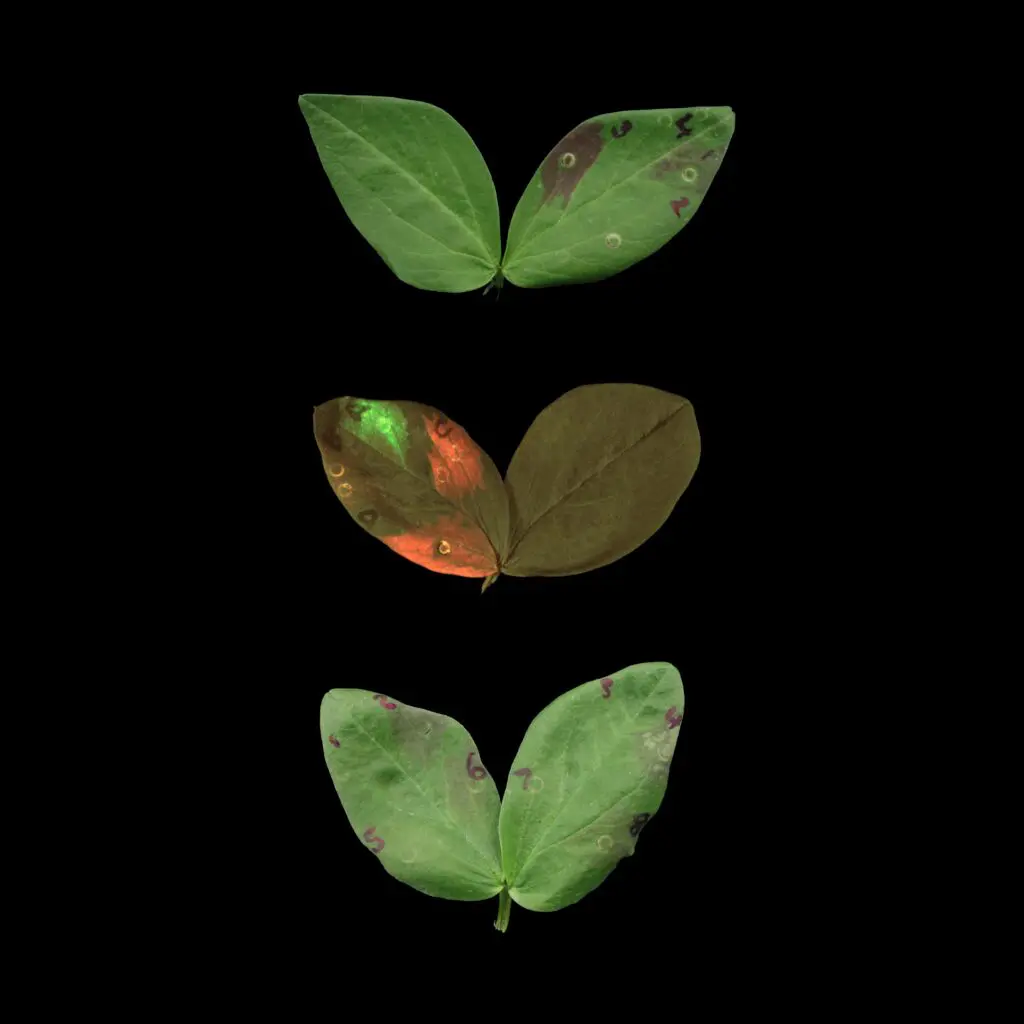
Striking image 3. Rhizobium rhizogenes AS109 unlocks transient functional assays in faba bean (Vicia faba). Images taken by Freddie J. King.
A bacterial delivery service
The team uses an engineered strain of the bacterium Rhizobium rhizogenes, called AS109, to deliver genetic instructions into leaves. Through “transient expression”, plant cells temporarily produce proteins that researchers can investigate.
The approach works in crops including sweet potato, mustard and faba bean, better known as broad bean.
In broad bean leaves, the researchers demonstrated three complementary methods: cell death assays to test immune responses, gene silencing to reduce the expression of a target gene and confocal microscopy to locate fluorescently labelled proteins inside cells.
Controlled cell death can help plants contain infection by sacrificing cells around an invading pathogen. These experiments allow researchers to investigate how that response is activated.
The team also showed that certain immune receptors from the family containing tobacco and potato retained their pathogen recognition and cell death functions in broad bean. This offers a way to test whether useful defence mechanisms could function across distantly related crops.
Together, these findings connect experiments inside individual leaves to a wider ambition: protecting valuable sources of protein.
From healthier plants to more reliable protein
The team proposes faba bean as a new model system for studying legume immunity. This would provide a testing ground for understanding defences relevant to a crop family that includes major sources of dietary protein and livestock feed, such as soybean.
“I am particularly excited to see researchers using this expression system in faba bean, which we propose as a new model species for developing disease resistance in legume crops,” said King.
Improved disease resistance and harvests in the field remain to be demonstrated. But these tools could help researchers identify and test promising resistance genes, bringing discoveries in the laboratory closer to protecting the food on our plates.
All images were taken by authors on the original manuscript and may be published under a CC-BY license.