Meet the six startups selected for the Sustainable Food Accelerator
The future of food is taking shape in laboratories, workshops and young businesses. For six ambitious startups joining the Sustainable Food Accelerator, the next challenge is to turn that potential into products, partnerships and businesses that can grow.
Working across microbial fermentation, food by-product valorisation, nutrient recovery and biopreservation, the selected ventures are exploring new ways to produce protein and fibre ingredients, recover vitamins and minerals, simplify food formulations and extend shelf life. Each brings a different technology and perspective, but they share a determination to tackle problems that matter to the food industry.
Now, with support from Cargill, Danone, Kerry and Mars, alongside Imperial’s scientific and entrepreneurial expertise, they will take the next steps towards putting their innovations into practice.
Delivered by the Bezos Centre for Sustainable Protein, Microbial Food Hub and Undaunted at Imperial College London, the Sustainable Food Accelerator connects emerging food and biotechnology ventures with the research expertise, venture-building support, specialist facilities and industry relationships that can help them move towards commercialisation.
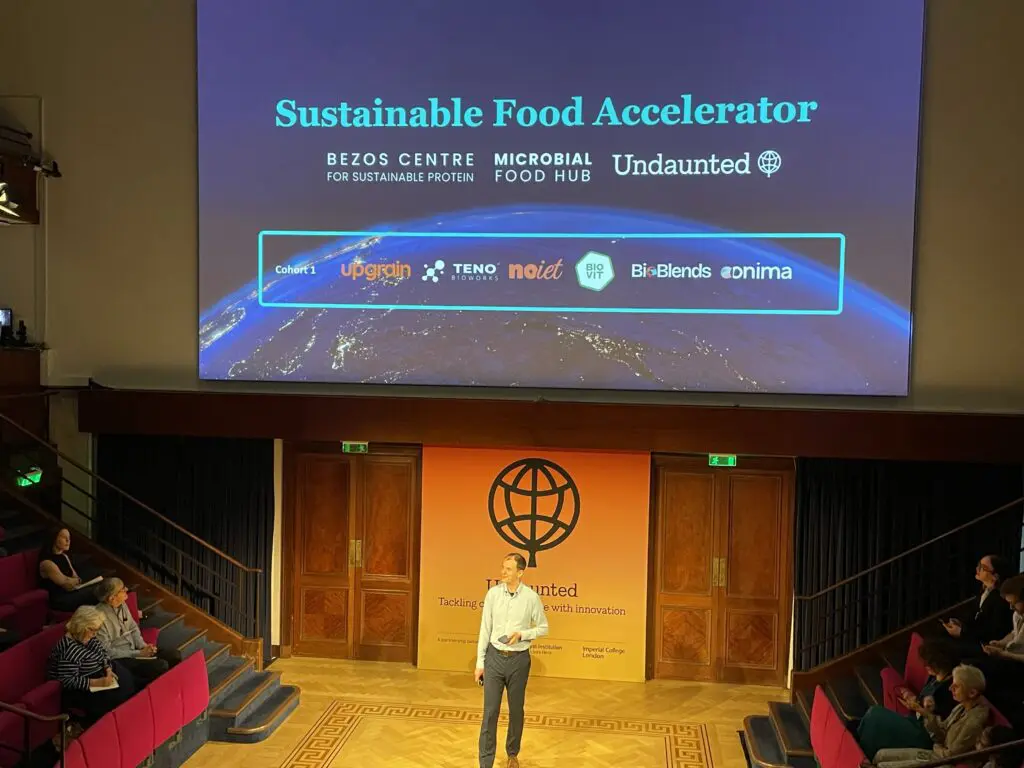
From 300 startups to 30 to 6
The six companies emerged from a selection journey that began with 300 startups and brought 30 shortlisted ventures to Imperial’s White City Innovation District for a two-day Selection Bootcamp on 22–23 September.
Across the Bootcamp, founders worked with scientists, investors, industry experts and startup coaches to examine their technologies, sharpen their propositions and explore where their businesses could make the greatest difference.
The conversations went beyond what their technologies could do. Teams considered who would use them, how they could fit into food production and what it would take to make them commercially viable. Cargill, Danone, Kerry and Mars contributed industry insight, helping founders connect their ideas with the needs and challenges facing the global food sector.
The selected startups will now join a programme combining scientific and technical expertise with commercialisation support, corporate engagement and venture building. Through the Bezos Centre for Sustainable Protein, Microbial Food Hub and Undaunted, founders will be able to draw on complementary strengths in sustainable food research and entrepreneurship, supported by Imperial’s wider innovation ecosystem.
Meet the Sustainable Food Accelerator cohort
Meet the six companies taking their next steps towards the future of food.



BioBlends
BioBlends extends the shelf life of food with gas-based biopreservatives inspired by the natural defence mechanisms of beneficial bacteria. Acting in the gas phase, they control mould and spoilage and fit into existing production lines without changing how food is made. Led by three PhD scientists and an industrial engineer, we are validating the technology with global food manufacturers across multiple food matrices, starting with bakery.
Around a third of the food produced worldwide is lost or wasted, and spoilage from mould and bacteria is a major driver. Synthetic preservatives face growing regulatory and consumer pressure, while natural alternatives are often less effective, costlier, or alter taste and texture. The industry still lacks a solution that extends shelf life without compromising the product.
BIOVIT
BIOVIT’s Circular Micronutrition System recovers vitamins and minerals from any food or drink processing side-stream. BIOVIT returns the recovered micronutrients to the human food chain as clean-label ingredients, and offers producers the ability to reincorporate them into the waste-producing products for true closed-loop circularity.
Food and drink processing generates millions of tonnes of nutrient-rich waste every year. This waste is then downcycled into feed, compost or biogas. Meanwhile, fortified products depend on synthetic vitamins and mined minerals that conflict with clean-label, organic and sustainability objectives. BIOVIT offers industry a food-grade process to recover those micronutrients at industrial scale.
NOIET
NOIET is developing multifunctional clean-label ingredients rich in protein and fiber, with preservative and antioxidant functionalities. Through proprietary multi-microbial fermentation, we transform plant-based by-products into ingredients that deliver nutrition and bioprotection together, helping manufacturers replace multiple additives, simplify labels and unlock greater value from resources the food industry already produces.
Food manufacturers face growing consumer demand for simpler labels and better nutrition. Yet replacing conventional additives while increasing protein and fiber often requires multiple ingredients, raising production costs and increasing formulation complexity. NOIET addresses this gap with one multifunctional clean-label ingredient combining protein, fiber, and natural preservative and antioxidant functionalities.
Onima
Onima has developed a patented breakthrough bioprocess that transforms spent brewer’s yeast, a bitter brewing byproduct, into a premium protein and wholesome nutrition ingredient. By stripping away hop-derived bitterness while preserving the whole-cell nutritional matrix, we deliver top performing nutrition that can be incorporated into everyday foods.
Global protein demand is surging, but conventional animal and plant proteins struggle with either affordability, taste, or environmental footprint. Meanwhile, breweries waste hundreds of thousands of tons of nutrient-dense yeast. We bridge this gap by upcycling this local biomass into an affordable, pleasant tasting, high-inclusion food ingredient with 50% protein, 30% fibre, and other key bioactive compounds such as prebiotic fibres or antioxydants.
TENO
TENO is on a mission to produce the most nutritious protein for humans, pets and animals—meeting increasing demand without wrecking the planet. Building on top of a decade of research at ETH Zurich, TENO grows specialized microbes from CO2-derived green methanol without relying on arable land and independent of the seasons.
Global population growth, changing lifestyles and rising affluence are driving an unprecedented surge in protein demand which is projected to grow by tens of millions of tons over the coming decades.
Legacy supply chains are already failing to keep pace, resulting in commodity prices like whey protein at record highs. Compounded by climate volatility and extreme weather events like El Niño, the current protein infrastructure is fundamentally unsustainable.
UpGrain AG
UpGrain AG is a Swiss food-tech company that turns brewer’s spent grain, the largest by-product of beer brewing, into food-grade protein and fibre ingredients. Our patented, purely mechanical process separates the grain into two fractions without enzymes or chemicals, giving food manufacturers clean-label, sustainable and price-competitive ingredients.
Breweries produce millions of tonnes of spent grain every year, most of it sold cheaply as animal feed or discarded, even though it is rich in protein and fibre. Meanwhile, the food industry is searching for affordable, sustainable protein. UpGrain closes that gap by turning an overlooked side stream into a high-value food ingredient.
Building towards what comes next
For the six selected teams, joining the cohort is the start of a new phase of development.
Over the coming months, they will work with specialists across Imperial, the Bezos Centre for Sustainable Protein, the Microbial Food Hub, Undaunted and the accelerator’s industry partners to further validate their technologies and develop their business models.
The aim is to help founders build the evidence, relationships and commercial understanding needed to progress towards pilots, partnerships, investment and scale. Along the way, they will explore how their technologies could meet industry needs and what it will take to bring them closer to market.
“Building a food business takes scientific rigour, commercial focus and the right people around you. By bringing these strengths together, we want to help the cohort make tangible progress, whether that means answering a critical technical question, developing a potential partnership or preparing for the next stage of growth.”
Julia Espeso-Bischofberger, Venture Manager
The six startups will also feature at the Bezos Centre for Sustainable Protein Annual Conference on 3–4 March 2027, where the Sustainable Food Accelerator will form part of the programme.
Follow the cohort
Behind each venture is a team working to turn a scientific possibility into something people can use. Over the coming months, we will introduce the founders, explore their technologies and share the milestones that mark their progress through the Sustainable Food Accelerator.