The Challenge
Alternative proteins from plants, fungi, algae, and microbes have immense potential to support a sustainable and resilient food system. However, many suffer from incomplete essential amino acid (EAA) profiles and poor digestibility, limiting their nutritional performance compared to animal proteins.
The challenge was to develop a computational and AI-assisted workflow capable of screening vast protein databases to identify highly digestible, EAA-rich candidates. The goal was to build a scalable bioinformatics pipeline that could predict digestibility and nutritional quality directly from sequence and structure data, enabling more targeted discovery of superior protein sources for food and feed.

The Approach
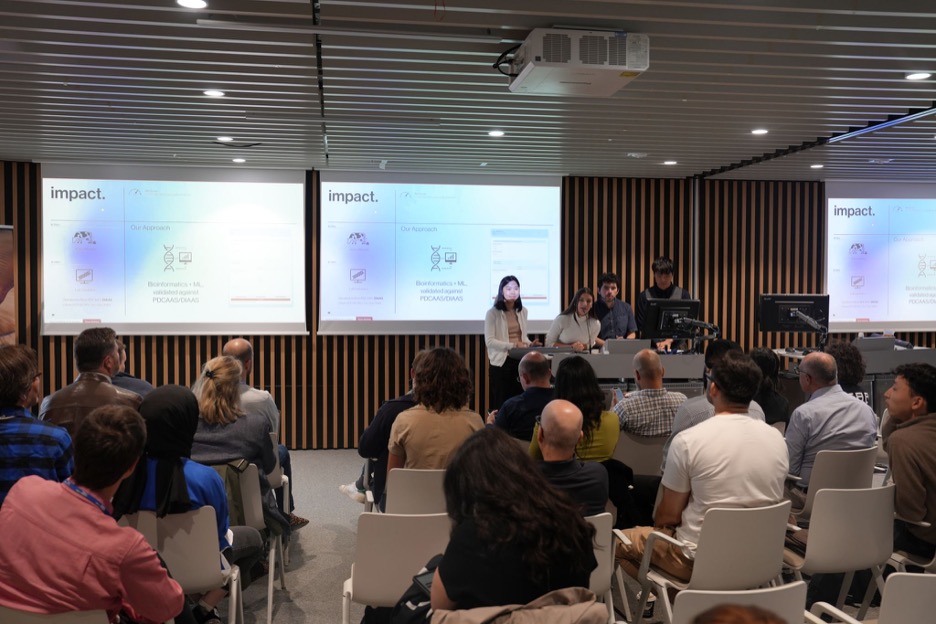
The team developed a prototype analytical platform, BiteScore, that integrates bioinformatics, machine learning, and protein structure prediction into a unified pipeline. The system combines data from AlphaFold, UniProt, and NCBI to extract sequence and structure features relevant to digestion, while applying predictive algorithms benchmarked against FAO/WHO protein quality standards (PDCAAS and DIAAS). Protease recognition site analysis was used to estimate cleavage accessibility and overall digestion efficiency, while comparative scoring and visualization enabled ranking of multiple proteins according to their predicted digestibility and nutritional balance.
To make the results interpretable for end users, LLM-assisted summaries provided contextual insights and recommendations for further experimental validation. By benchmarking the workflow against well-characterized proteins such as milk and egg, the team ensured both biological plausibility and predictive robustness of the model.

The Outcome
The resulting BiteScore App is a functional prototype capable of predicting and visualizing protein digestibility in minutes. It enables standardized, reproducible, and ethically sound assessment of protein quality, reducing dependence on labor-intensive in vivo experiments. By automating digestibility prediction and integrating seamlessly with proteomic workflows, BiteScore has the potential to accelerate R&D pipelines across food technology, nutritional science, and synthetic biology. Ultimately, this tool lays the groundwork for data-driven protein design, guiding the development of more nutritious and sustainable ingredients for the future food system.