Researchers have shown that reducing variation between engineered yeast cells can increase bioproduction by up to threefold, pointing to a new way of designing more efficient microbial production systems.
Microbial fermentation is increasingly being used to produce food ingredients, chemicals, and other useful compounds. It is also an important part of efforts to develop more sustainable manufacturing methods, as biological systems can use different feedstocks and operate under different conditions from many conventional industrial processes.
Graphical Abstract
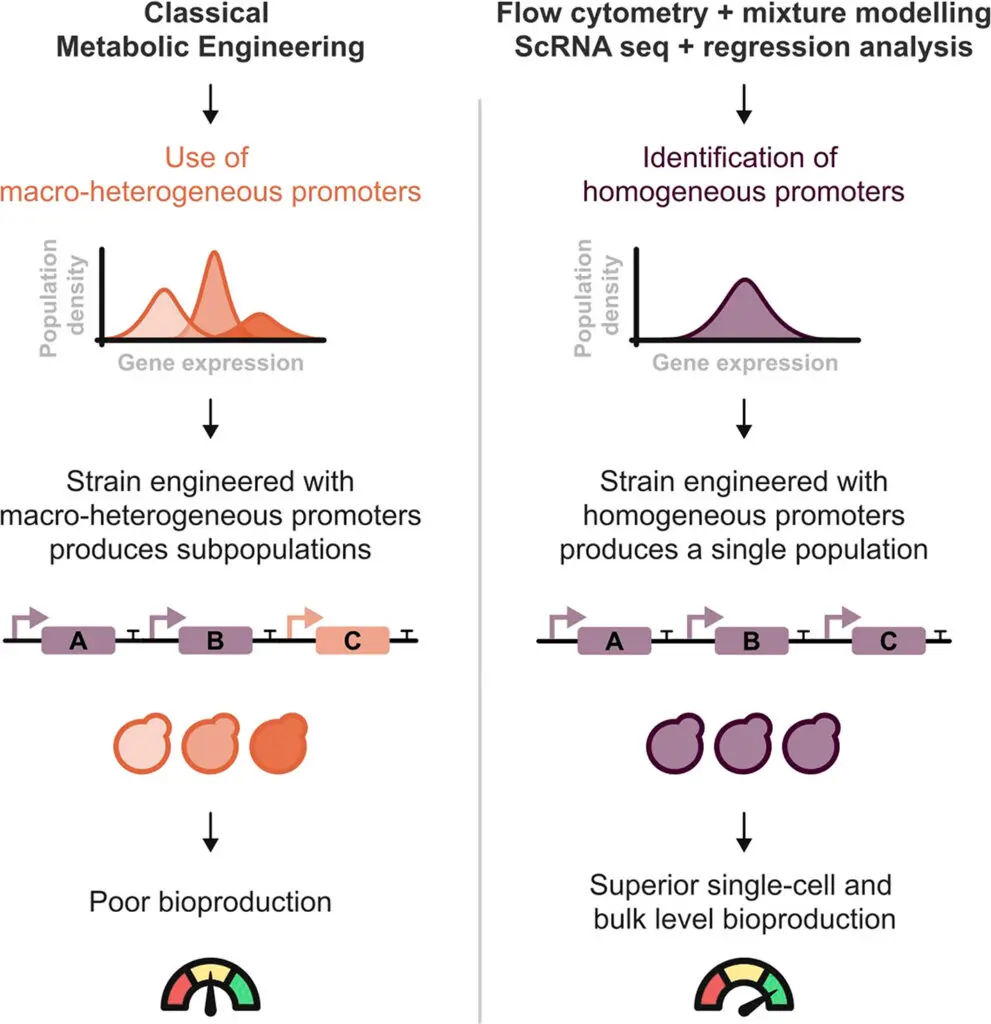
More homogeneous promoters reduce cell-to-cell variability, helping engineered yeast populations perform more consistently and improving overall bioproduction.
WHY CONSISTENCY MATTERS
Microbial fermentation relies on large population of cells working together to produce a target compound. But even genetically identical cells do not always behave the same way. During fermentation, some cells may be highly productive while others produce much less, creating cell to cell variability, or heterogeneity, across the population.
This variability can become particularly important at larger scales, where differences in nutrients, oxygen, temperature and other conditions can amplify differences between individual cells. As a result, a proportion of the population may perform below its potential, reducing the overall efficiency of the fermentation process and the amount of product that can be made.
Until recently, this has been difficult to investigate because conventional measurements typically report the average behaviours of an entire cell population, potentially masking substantial differences between individual cells. Advances in single-cell technologies now make it possible to examine this variability directly, understand where it comes from and identify strategies to minimise it.
PROMOTERS AS A SOURCE OF VARIABILITY
One factor that can influence this cell-to-cell variability is the choice of promoter. Promoters are regions of DNA that regulate when and how strongly genes are expressed. They are widely used in engineering biology to control metabolic pathways and determine how microorganisms product a target compound.
The team tested 19 commonly used promoters in the yeast Saccharomyces cerevisiae, the most widely used fermentation microorganism, and found that several produced distinct populations of high- and low-expressing cells.
Other promoters were much more homogeneous, producing relatively consistent expression across the cell population and across different growth conditions.
This suggests that promoter strength alone may not be enough to predict how well a microbial production system will perform.
A promoter may generate high average expression while still producing a significant number of poorly performing cells. By contrast, a more homogeneous promoter may support a greater proportion of productive cells across the populations
HIGHER PRODUCTION FROM MORE UNIFORM CELLS
To test the effect on bioproduction, the researchers engineered yesterday to produce lycopene, a carotenoid used in food, pharmaceuticals and cosmetic products.
They compared strains using homogeneous promoters with strains containing promoters that produced greater cell-to-cell variation.
Using single-cell Raman spectroscopy, the researchers found that yeast strains with homogeneous promoters produced between 1.2 and 2.9 times more lycopene on average.
The effect was also observed at population level. When production was normalised to biomass, homogeneous strains produced two to four times more lycopene per gram of biomass than heterogeneous strains.
Importantly, the most productive design was not always the one with the strongest promoter. In some cases, a more consistent promoter performed better despite having lower overall expression strength.
The findings therefore suggest that promoter heterogeneity should be considered alongside promoter strength when engineering microbial production systems.
Strain construction for the production of lycopene and detection by Raman spectroscopy.
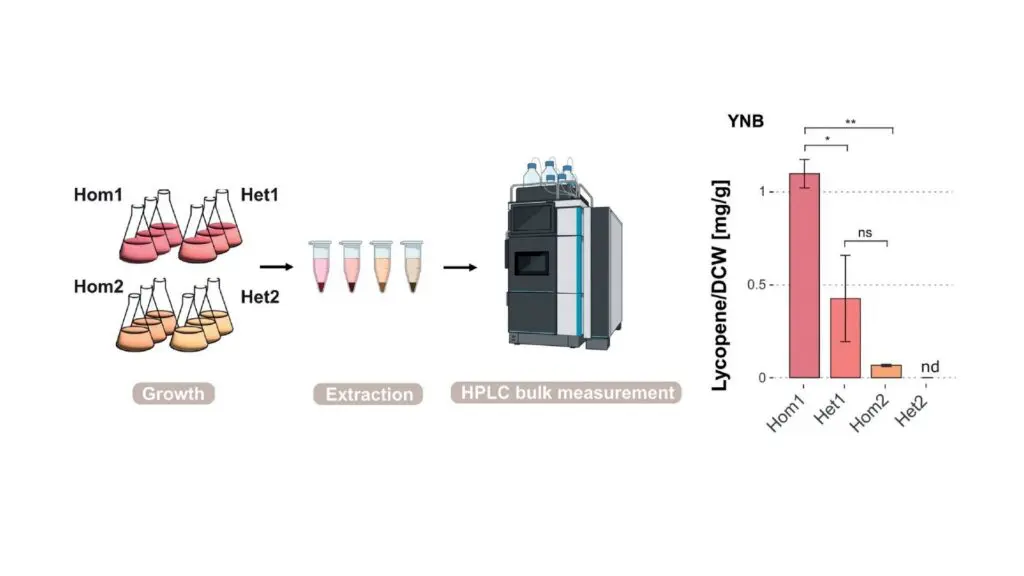
Four engineered yeast strains were tested for their ability to make lycopene, a natural food colourant and antioxidant. Strains that behaved more consistently produced around twice as much lycopene.
MAKING BIOLOGY WORK HARDER TOWARDS MORE EFFICIENT BIOMANUFACTURING
For sustainable food and biomanufacturing, this could have broader significance. Increasing the amount of useful product generated from the same microbial biomass could improve the efficiency of fermentation processes, and if the effect is maintained at scale, potentially reduce the amount of feed stock, production capacity and other resources required per unit of product.
The researchers also used single-cell RNA sequencing data and predictive modelling to explore whether promoter behaviour could be identified in advance, providing a possible route towards more informed strain design.
The work remains at an early stage. The approach has so far been demonstrated in laboratory-scale shake-flask fermentation.
Further experiments in bioreactors will be needed to determine whether the productivity gains remain under industrial fermentation conditions. The findings could help address a wider challenge in engineering biology: how to translate high-performing laboratory systems into robust, efficient and scalable forms of biological manufacturing.
Rather than simply asking how strongly an engineering cell can produce, the study suggests that an equally important question may be how consistently the entire population performs.