Microorganisms are increasingly being engineered to produce everything from food ingredients and proteins to chemicals and fuels. But scientists cannot fully exploit this if they do not know what many of the proteins inside these organisms can do.
Even in well-studied microorganisms such as yeast and Escherichia coli, more than 30% of gene products are missing a molecular function annotation. Traditional methods often predict function by comparing the amino acid sequence of an unknown protein with proteins that have already been characterised. As proteins evolve, however, their sequences can change substantially even when their underlying structures and functions remain similar.
Now, researchers at the Bezos Centre for Sustainable Protein and the Microbial Food Hub at Imperial College London have developed WASP (Whole-proteome Annotation via Structural-homology Prediction). WASP is a computational pipeline that instead looks at the three-dimensional shapes of proteins.
Overview of WASP pipeline
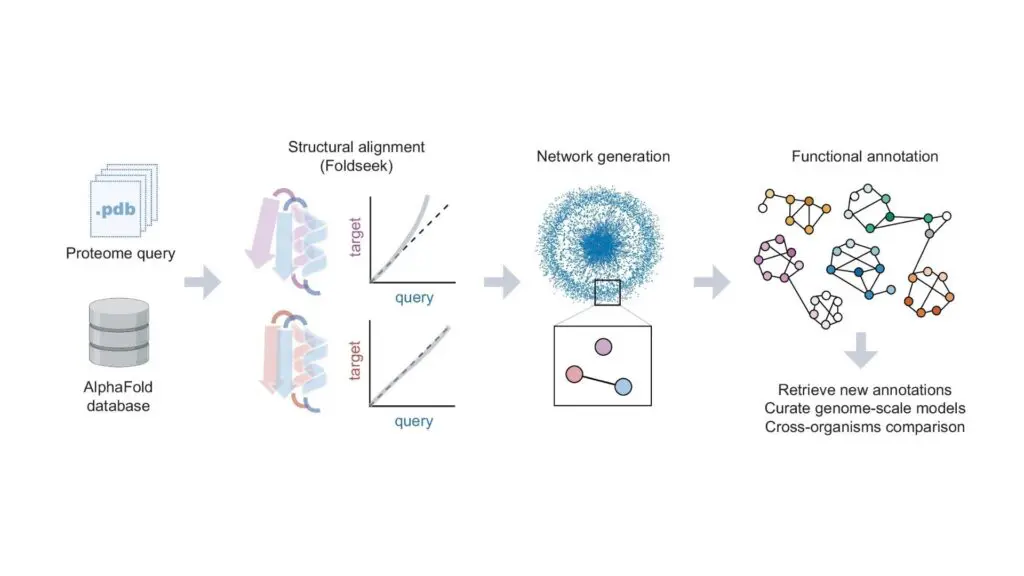
WASP compares protein structures, builds networks of related proteins and uses existing annotations to predict unknown protein functions.
LOOKING BEYOND THE GENETIC SEQUENCE
The development of AI systems such as AlphaFold has transformed scientists’ ability to predict the three-dimensional structures of proteins directly from their amino acid sequences.
WASP builds on that advance by comparing predicted protein structures with millions of existing AlphaFold models and analysing networks of structurally related proteins.
Because protein structure is closely linked to function, this allows the system to identify relationships that conventional sequence comparisons can miss.
When tested against existing protein annotation approaches, WASP achieved strong performance and was particularly useful for identifying functions where evolutionary changes had made sequence similarity difficult to detect.
Structural versus sequence-based homology in the FtsZ/tubulin protein family.
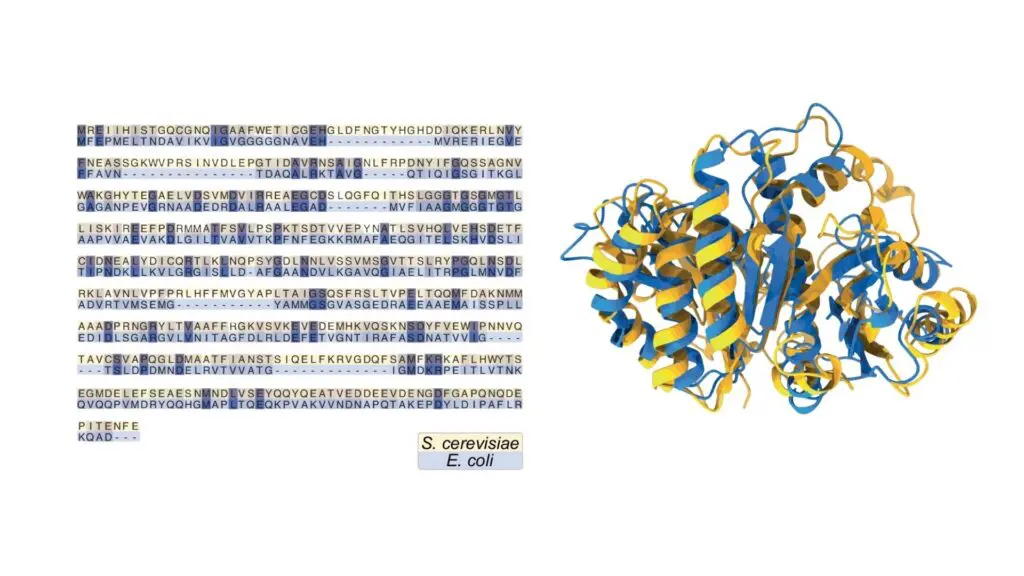
Proteins with very different amino-acid sequences (A) can still form highly similar three-dimensional structures (B). These two proteins have the same function, which is only easy to spot if we compare structures and not sequences. Comparing protein structures can therefore reveal biological relationships that sequence-based approaches may miss.
EXPANDING THE BIOLOGICAL TOOLKIT
The research applied WASP to 20 microorganisms with industrial applications, including bacteria, yeasts, and fungi. For some less-well characterised species, the system predicted functions for 20-30% of proteins that previously lacked an annotation. This could be particularly useful in engineering biology, where researchers increasingly look beyond a small number of conventional laboratory organisms for microbes with useful natural characteristics.
One example is Yarroqia lipolytica, a yeast already studied for applications in precision fermentation. WASP was able to identify functions for proteins missed by several existing annotation approaches, providing a more complete picture of the organism’s biological capabilities.
A better understanding of these organisms could help researchers identify new enzymes, metabolic pathways and biological functions that can be used when designing microbial production systems.
FILLING GAPS IN MICROBIAL FACTORIES
The team also tested whether WASP could improve genome-scale metabolic models which are computational maps used to understand and predict how microorganisms process nutrients and produce different compounds.
These models often contain “orphan reactions”: metabolic activities that scientists know take place but cannot yet link to the protein responsible. Across the 20 organisms studied, WASP identified potential native proteins for 75-100% of these orphan reactions where suitable reference information was available.
Filling in these gaps could help researchers build more accurate models of microbial metabolism and make more informed decisions about which genes or pathways to engineer.
UNLOCKING THE HIDDEN POTENTIAL WITH(IN) MICROBIAL PROTEOMES
For sustainable biomanufacturing, the significance lies in making better use of biology that already exists. Microorganisms contain enormous biochemical diversity, but much of it remains poorly understood. Tools that reveal previously hidden protein functions could expand the range of enzymes and organisms available for producing food ingredients, chemicals and other materials through biological processes.
WASP does not replace experimental validation, and its predictions remain dependent on the quality of existing structural and functional information. The researchers note that some proteins still form poorly understood “dark” regions where there is not enough information to confidently assign a function. By combining AI-generated protein structures with network analysis, the approach offers another way to explore this biological unknown.
As engineering biology moves towards designing more efficient and specialised microbial production systems, understanding what proteins do, including those that conventional methods have overlooked, could help turn previously hidden biology into new tools for more sustainable manufacturing.