From plant-based burgers to proteins made through fermentation, conversations about the future of food often focus on what ends up on our plates. But another question deserves attention: where will these foods be made, and who will benefit?
A review involving researchers at the Bezos Centre for Sustainable Protein and Imperial College London’s Centre for Environmental Policy examines how food producers choose factory locations. Published in Frontiers in Sustainable Food Systems, it explores what those decisions could mean for a fair transition towards alternative proteins.
The research highlights a gap: commercial considerations dominate the existing evidence, while social and environmental factors rarely feature.
What puts a place on the map?
Led by Henry Bambrick, alongside Adrian Leach, Rodrigo Ledesma-Amaro and Tilly Collins, the study reviewed 16 papers investigating the location of food-processing facilities.
The researchers identified 44 factors influencing these decisions. Four stood out: labour costs, access to customers, proximity to suppliers and raw materials, and being near other businesses in the same sector.
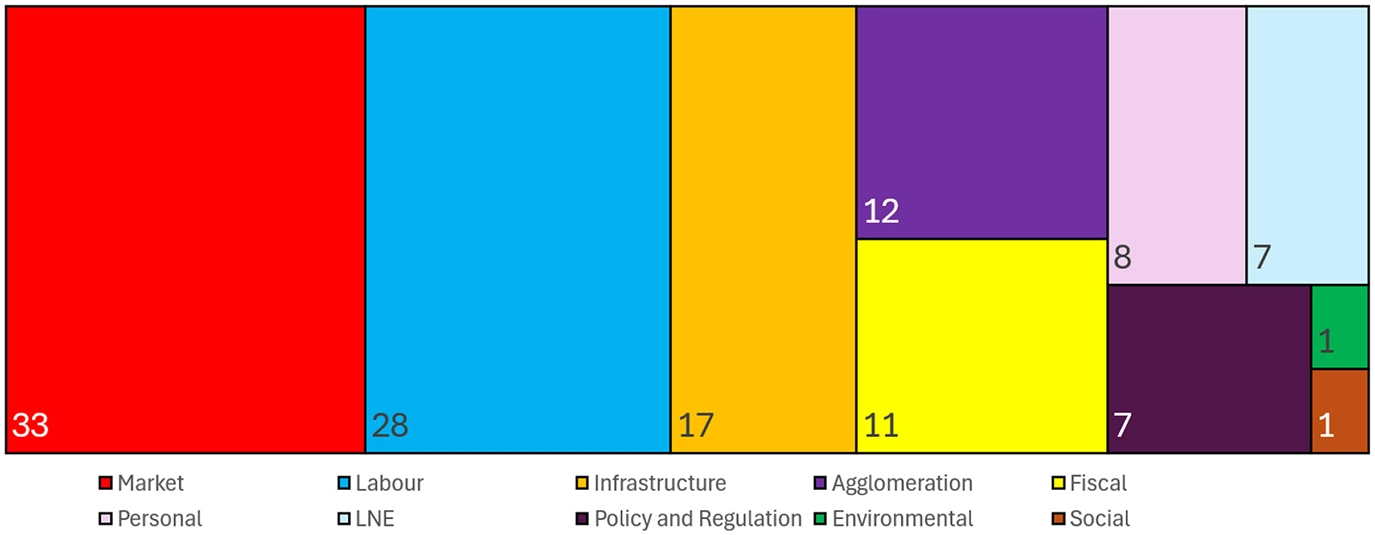
Figure 1 – Shows the relative proportion of mentions by category across all reviewed literature. LNE = Local Natural Environment.
The logic is straightforward. Nearby suppliers can simplify deliveries, good market access helps products reach customers, and established industrial areas can provide infrastructure and workers.
For alternative protein companies trying to make affordable products, these practical considerations matter. Businesses must be commercially viable before their potential benefits can reach people at scale.
Yet choosing a location also shapes opportunities beyond the factory gates.
The people behind the postcode
A new production facility can bring employment, investment and infrastructure to an area. Where it is built therefore influences which communities gain those opportunities—and which may miss out.
Across the reviewed studies, only one included a factor classified as environmental, and only one included a social factor. Labour featured frequently, but primarily through an economic lens.
This does not establish that every food company overlooks people or the planet. It shows how little attention these considerations receive in the research examined.
The authors argue that a “just protein transition” must consider how benefits and costs are shared, whose voices influence decisions, and whether existing inequalities are reinforced.
For communities dependent on livestock farming, these questions could become particularly important as production systems change.
Farmers belong in the picture
That connection makes collaboration with agriculture essential. Alternative protein production still depends on farming: plant-based foods need crops, while fermentation and cultivated meat can use agricultural products or by-products as inputs.
The authors therefore highlight the importance of working with farmers and involving rural residents and local authorities in location decisions.
Government incentives could also help influence where facilities emerge, potentially directing investment towards communities that might otherwise be overlooked.
The challenge is to make those choices commercially workable while giving social and environmental outcomes meaningful weight.
Building the evidence for better decisions
Before these ideas can guide new factories, however, researchers need a clearer understanding of the sector’s specific requirements.
None of the reviewed studies focused directly on alternative protein production. Most examined settings in the United States or Japan, including Japanese investment in China, and the papers spanned 1989 to 2021.
Their findings offer useful starting points but cannot simply be applied everywhere. A cultivated meat facility may need different expertise and infrastructure from a plant-based food factory or fermentation business.
Future research should examine those differences, alongside the trade-offs between large, centralised factories and smaller, more widely distributed sites.
For the Bezos Centre for Sustainable Protein, this work brings the wider context of food innovation into focus. Decisions about where production happens could help determine whether scientific advances create opportunities that are shared more fairly.